

Last updated September 10, 2026
Full 25-point door and opener safety check with every visit - springs, cables, rollers, tracks, and your LiftMaster or Chamberlain opener included
You get a price before we start. It does not change when the truck arrives.
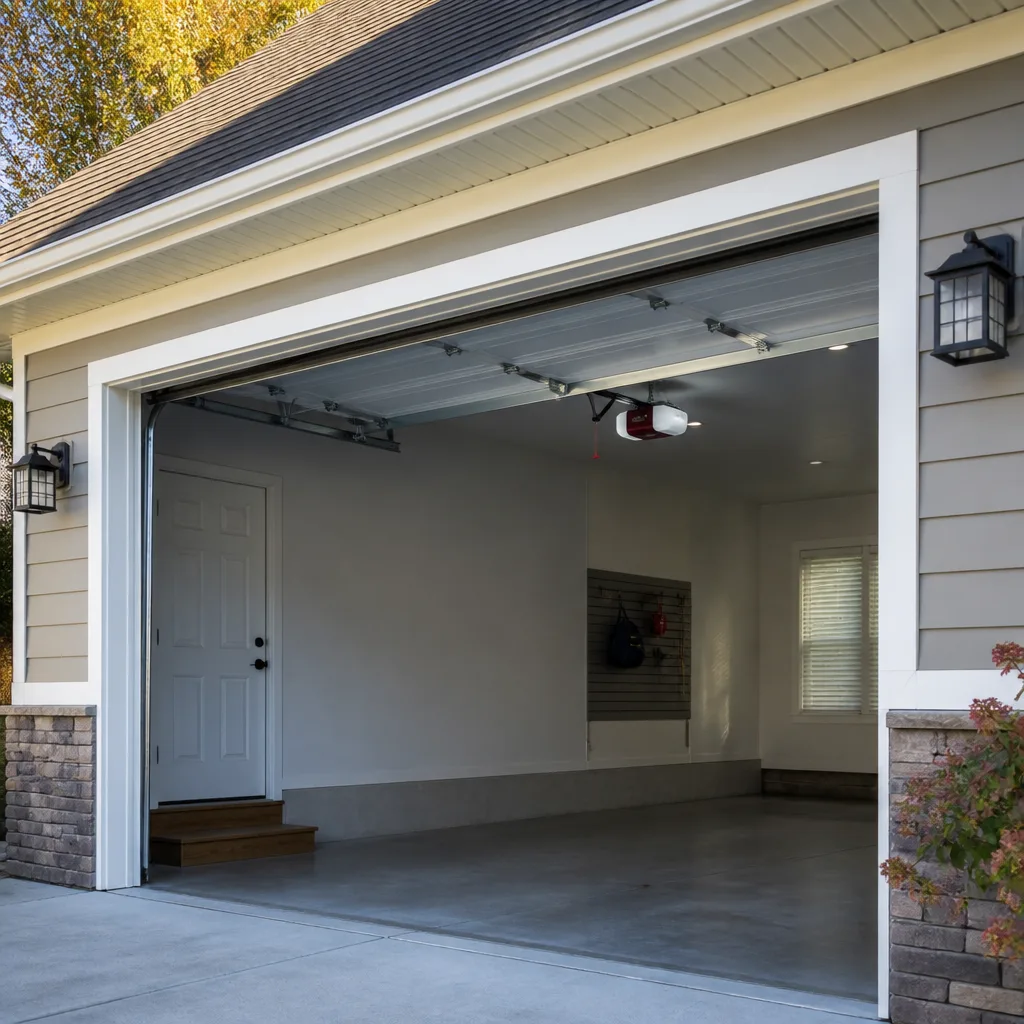
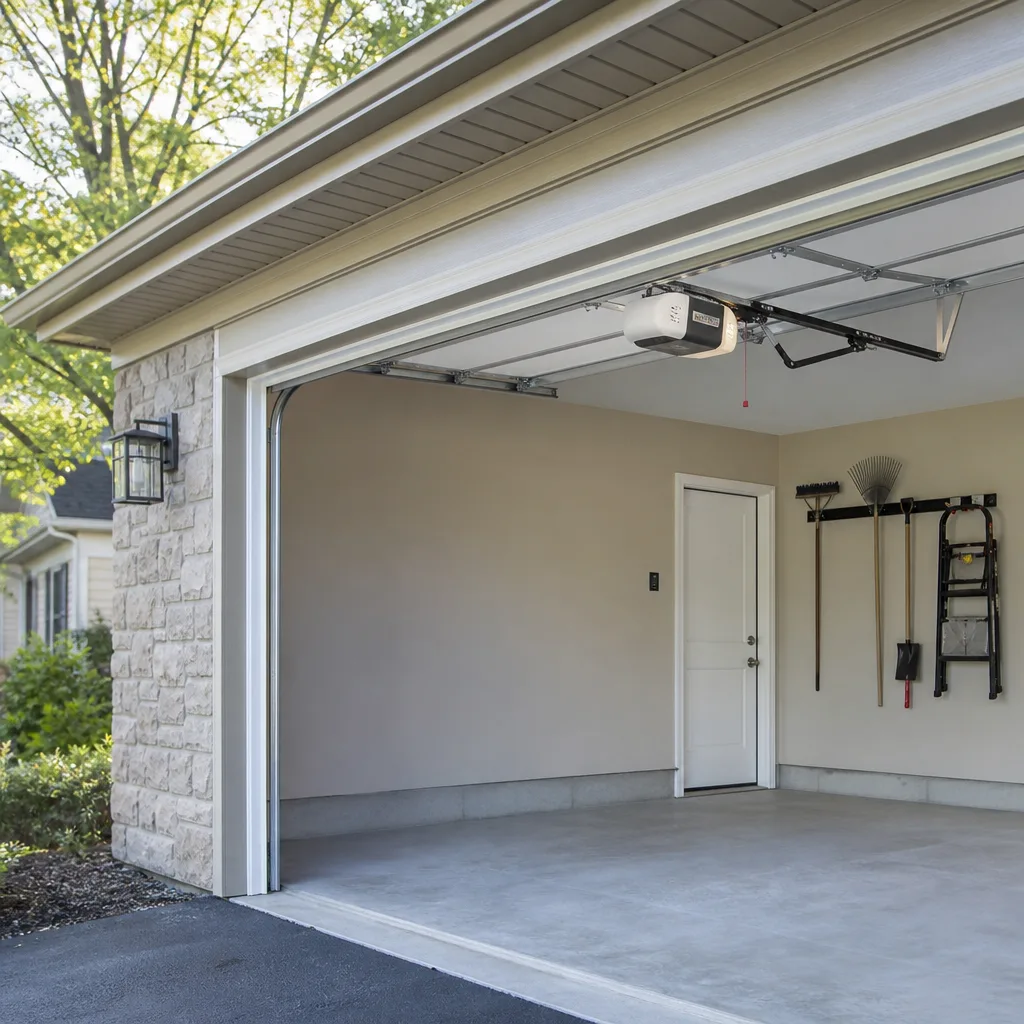
 Before
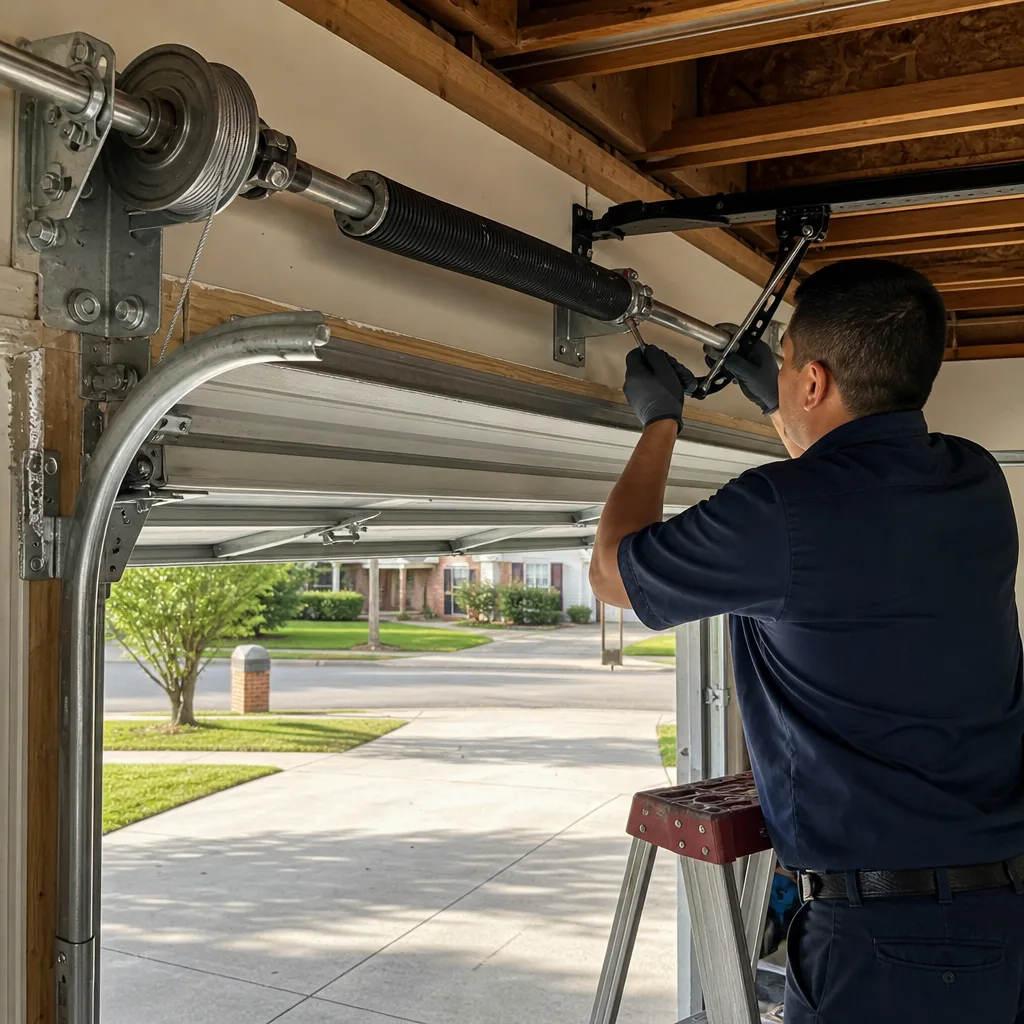 After
After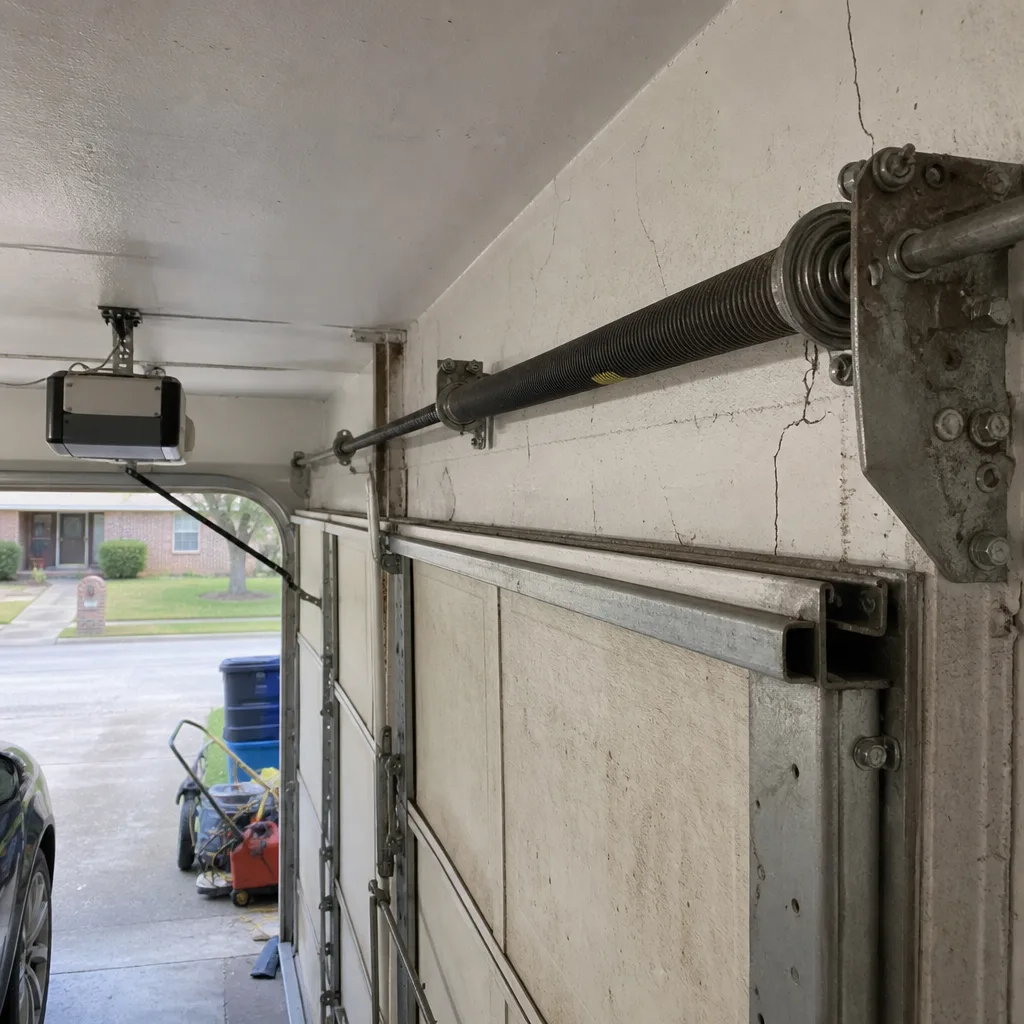 Before
 After
After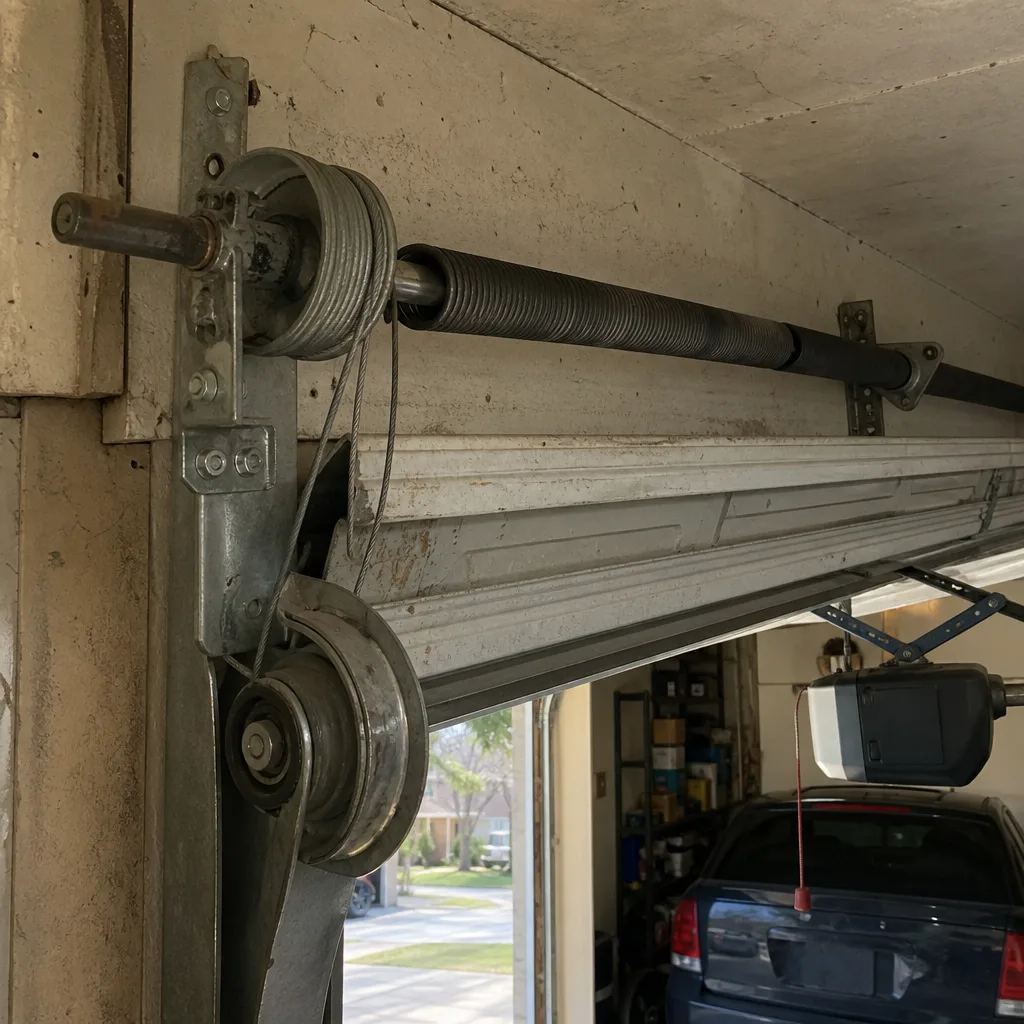 Before
 After
AfterThe Complete Guide to Garage Door in Garland
Your garage door moves more times per year than your front door does in a decade, yet most people cannot name a single part under that torsion bar. In Garland, where the clay soil shifts and the summer sun beats down on that big steel panel for twelve hours a day, your garage door is quietly doing real structural work. This guide explains how the whole system actually functions, what fails first in North Texas conditions, what repairs should cost, and how to talk to a tech without getting upsold. By the time you finish, you will know more about your garage door than the last three people who quoted it did.
Quick Answer
A garage door in Garland is a 150 to 400 pound moving wall suspended on springs, guided by tracks, and powered by an opener that has to survive 100°F summers, clay-soil foundation shifts, and roughly 1,500 open-close cycles per year. The most common Garland failure is a torsion spring snapping from cycle fatigue, which usually costs $180 to $340 to replace, and the most common hidden problem is track misalignment from soil movement that makes the door bind and the opener strain. You should have your door serviced once a year, never touch the springs yourself, and always get a written quote before work starts.
Table of Contents
- Garage Door Anatomy: Every Part That Can Fail
- Torsion vs. Extension Springs: Garland’s High-Use Reality
- How Garland’s Clay Soil Wrecks Garage Door Tracks
- Garland Heat and Your Garage Door: The Insulation Question
- What a Garage Door Does to Your Garland Home Appraisal
- A Practical Maintenance Schedule That Actually Works
- Common Mistakes to Avoid
- When to Call a Professional
- Frequently Asked Questions
Garage Door Anatomy: Every Part That Can Fail
You do not need to become a garage door mechanic. You do need to be able to name the thing that broke so that when you call someone, you can describe the problem accurately, and so that when the tech tells you what is wrong, it does not sound like a foreign language. Here is the plain-language map of a residential garage door system, from the bottom up.
The Door Itself: Panels, Hinges, Rollers, and Bottom Bracket
A sectional garage door in Garland is typically made of four or five horizontal panels, each connected to the next by steel hinges. The panels ride on rollers, small wheels that fit inside the vertical and horizontal tracks. At the bottom of the lowest panel, bottom brackets hold the lift cables that connect to the spring system. The bottom also carries the weather seal, a rubber strip that keeps rainwater, dust, and the occasional Texas field mouse out of your garage. When a door sags on one side, the bottom bracket is usually where the trouble starts. We see bottom brackets corroded through in Garland more than anywhere else we work, because the humidity combines with road salt residue from wet cars and eats the steel over about eight to ten years.
The Spring System: Torsion Tube, Cables, and Drums
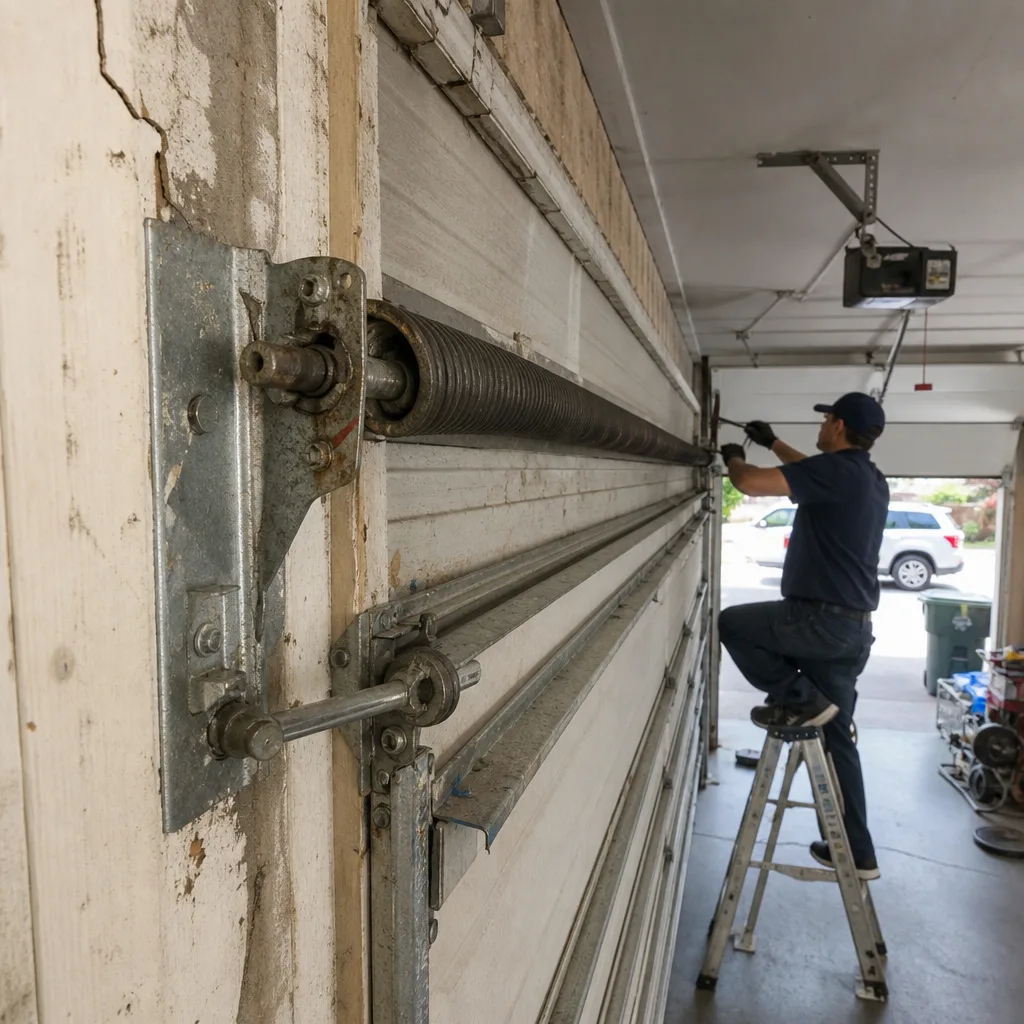
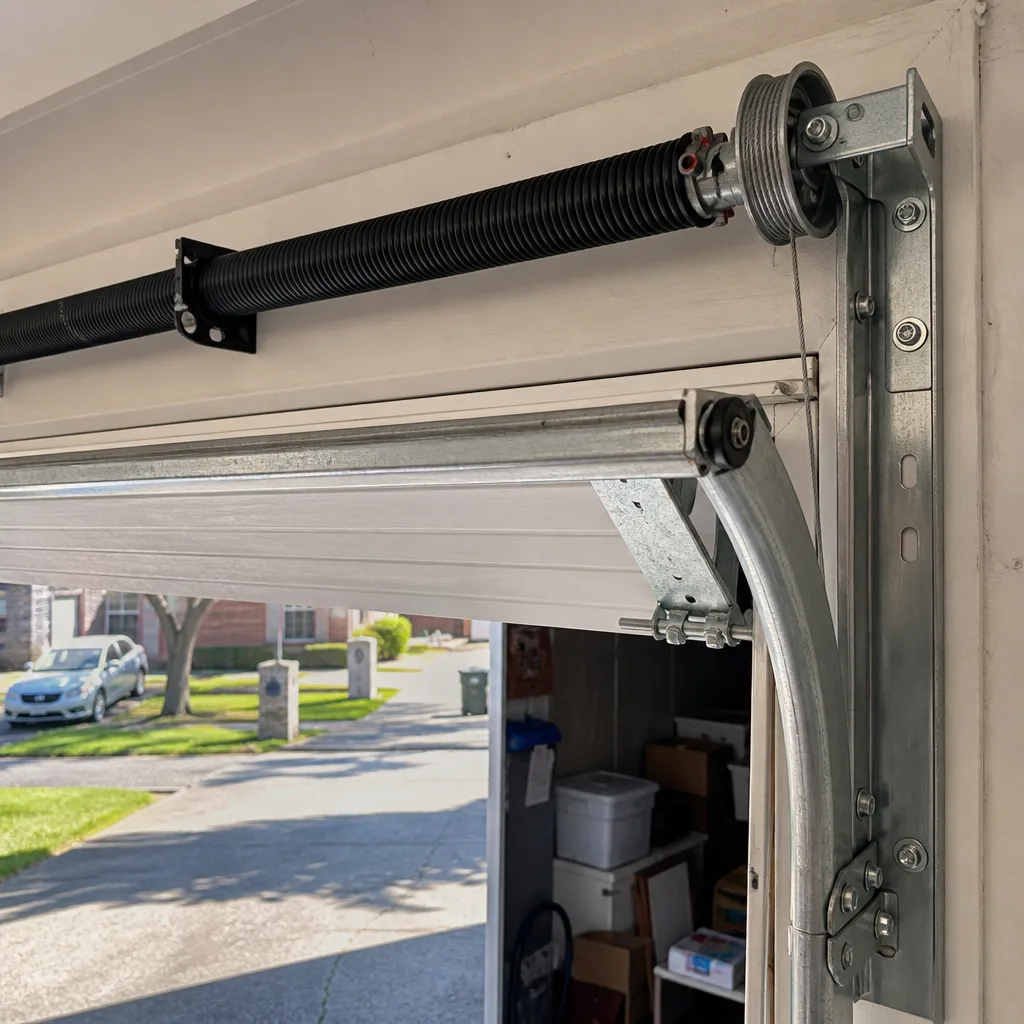
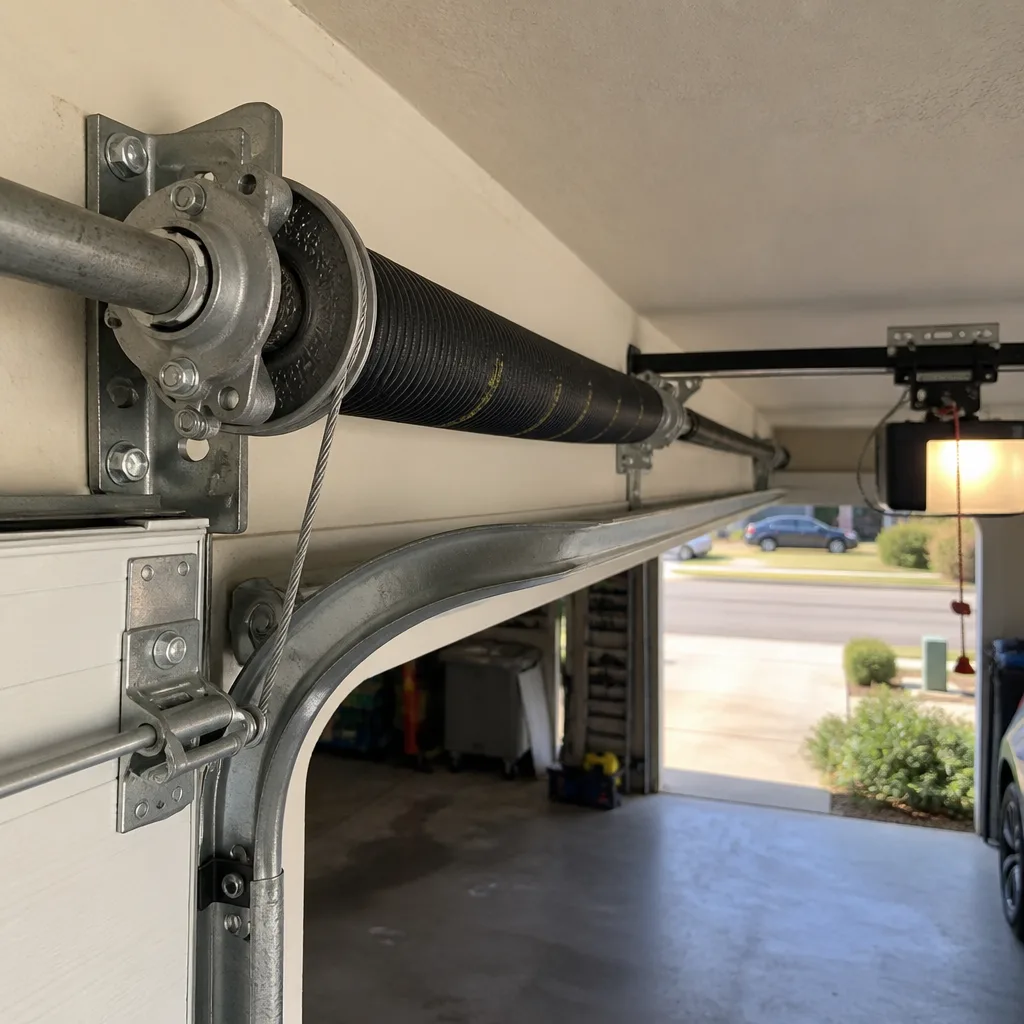
Above the door, mounted on a horizontal bar called the torsion tube, sit either one or two torsion springs. These are the muscles of the entire operation. They store the energy that lifts the door; the opener is just the finger that tells the springs when to let go. At each end of the torsion tube, cable drums wind and unwind the steel lift cables. When a torsion spring snaps, you will hear it, sometimes from inside the house. It sounds like a gunshot in the garage. If that happens, do not try to open the door by hand. The other spring, if there is one, is now carrying double its rated load, and the door can come down fast.
The Track and Opener
The track is the steel channel bolted to the wall and ceiling that guides the door from vertical to horizontal. The opener hangs from the ceiling, pulls or pushes a rail with a belt, chain, or screw drive, and is controlled by a logic board that talks to your wall button and your remotes. On LiftMaster and Chamberlain units from the last ten years, the logic board also runs the safety reversal sensors at the bottom of the track. When the door will not close and blinks at you, it is usually the sensors. When the door reverses for no reason at all, it is usually the logic board working exactly as designed, because something is in the beam path or the sensors are out of alignment.
Torsion vs. Extension Springs: Garland’s High-Use Reality
There are two kinds of garage door spring systems in North Texas homes: torsion springs and extension springs. The difference is not academic. One is significantly safer and lasts longer. The other is cheaper to install and still shows up in many older Garland houses, especially those built before 1990.
Torsion Springs
Torsion springs mount on a bar above the door and twist to store force. Most are rated for 10,000 cycles, which in a high-use Garland household, where the door opens four to six times a day, works out to roughly seven to ten years. Higher-cycle springs rated for 20,000 or 30,000 cycles are available. We install those when a customer tells us they use the garage as a front door, which in Garland is more common than not. The safety advantage of torsion springs is that when one snaps, it stays on the bar. The broken ends may spin, but the spring itself does not fly across the garage.
Extension Springs
Extension springs mount on either side of the horizontal track and stretch to store force. They are rated for fewer cycles, typically 5,000 to 7,000, and when one snaps, the broken end can whip through the air. If the safety cable is missing, and it often is on older Garland homes, a snapping extension spring becomes a projectile. We recommend replacing extension spring systems with a torsion conversion whenever a homeowner asks us to put in a new door. The cost difference is modest, and the safety difference is real. If your Garland home still has extension springs, inspect the safety cables. If there are none, have them added before the next cycle ends.
How Garland’s Clay Soil Wrecks Garage Door Tracks
Garland sits on expansive clay soil, the same Blackland Prairie clay that runs through Dallas County. It swells when it rains and shrinks when it dries, and over years of wet winters and scorching summers, it moves. Your foundation moves with it, not all at once and not evenly. The garage slab tilts a quarter inch one way, then a half inch the other. The walls that hold the garage door tracks tilt with it. The result, over time, is a track that is no longer perfectly plumb, which means the door no longer rolls true, which means the rollers bind, the cables wear unevenly, and the opener motor starts working harder than it was ever designed to work.
How to Spot It Before the Door Binds
- Watch the gap. Stand inside the garage and look at the gap between the door and the side jamb on each side. If one gap is wider at the top and the other is wider at the bottom, the door is cocked.
- Listen to the rollers. A door that was quiet and is now grinding, squealing, or thumping in one particular spot on the way up or down is telling you the track has moved under it.
- Check the floor. Look at the concrete floor along the wall where the track bolts down. Hairline cracks that run parallel to the wall are a sign of slab movement.
- Test the balance manually. Pull the release cord and lift the door halfway by hand. A well-balanced door stays put. A door that drifts down or springs up has a tension problem, which may be springs or may be track drag from soil shift.
Track realignment is a standard repair, not a replacement job, and it should cost a fraction of what a new door costs. But if you ignore it long enough, the drag destroys rollers, ovalizes the hinge holes, and eventually bends a panel. That is when a $150 fix becomes a $1,400 replacement.
Garland Heat and Your Garage Door: The Insulation Question
Your garage door is the largest single uninsulated surface on the front of your Garland home, and in July, the sun hits it for hours before it hits your living room wall. An uninsulated steel door can reach 130°F on the interior surface by 3 p.m. That heat radiates into the garage, soaks into the wall between garage and house, and drives up your air conditioning load. The garage door alone accounts for up to 30% of a home’s front-facing heat gain in a Garland summer.
What R-Value Actually Means at 100°F
R-value measures resistance to heat flow. A single-layer steel door has almost none, around R-1 or less. A double-layer door with a polystyrene core runs R-6 to R-9. A triple-layer door with polyurethane runs R-12 to R-18. Here is the practical version for Garland: if your garage is attached and you have a room above it, you want R-12 minimum. If your garage faces west and bakes all afternoon, you want R-16 or better. If your garage is detached and you only park cars in it, R-6 will do fine, and spending more is not buying you much. The insulation also deadens noise, which matters if the bedroom is above the garage and the opener runs at 6 a.m.
Seals Matter More Than Panels
Before you spend money on an insulated door, check the weather seal at the bottom and the rubber stops on the sides. A gap of a quarter inch along the bottom of a 16-foot door is a 48-square-inch hole letting conditioned air escape and 100°F air in. Replacing the bottom seal costs about $25 in parts and takes twenty minutes. It is the highest-value garage door improvement available to a Garland homeowner.
What a Garage Door Does to Your Garland Home Appraisal
Appraisers in Dallas County do not line-item a garage door the way they line-item a roof or an HVAC system, but they do not ignore it either. The garage door is one of the first things an appraiser photographs, and curb appeal and exterior condition factor into the comparable-sales adjustments. A dented, sagging, or visibly rusted door reads as deferred maintenance, and deferred maintenance shaves value. A clean, straight door in a neutral color with a working opener reads as maintained, and it protects your asking price.
If you are selling a Garland home and the garage door does not open, or opens with a groan, or has a panel pushed in from a basketball, fix it before listing. Expect to spend $150 to $400 on spring replacement or track alignment, or $1,200 to $3,500 on a full garage door installation in Garland if the door is beyond repair. What you spend will come back at closing and spare you the buyer’s concession letter asking for $2,000 off.
A Practical Maintenance Schedule That Actually Works
Most maintenance advice for garage doors is either too vague to follow or too detailed to remember. Here is a schedule that fits a Garland climate and a normal life. None of these tasks requires special tools, and all of them together take less than an hour per year.
Every Three Months
- Look at the door. Stand in the driveway and look at the panel lines. They should be straight. If they curve or sag, something underneath is shifting.
- Listen to the opener. Run the door once and stand under it. A smooth opener is quiet. A straining opener sounds like it is working hard, and it probably is.
Every Six Months
- Test the safety reversal. Lay a 2×4 flat under the door and close it. The door should reverse within two seconds of touching the wood. If it does not, stop using the opener and call for service.
- Check the balance. Pull the release cord and lift the door halfway by hand. It should stay. If it drops, the springs are tired or the track is binding.
- Clean the photo eye lenses. A dry cloth removes the dust film that triggers false reversals in Garland’s dry, windy months.
Once a Year
- Lubricate the moving parts. White lithium grease on the hinges and rollers, and a light machine oil on the torsion spring. Do not use WD-40 on the rollers; it is a solvent, not a lubricant.
- Inspect the weather seal. Look for cracks, flattened sections, or places where light shows through under the door.
- Check the cables and spring. Look at the lift cables for frays and the spring for gaps between coils. Do not touch either. If something looks wrong, call a professional. A door is 200 pounds riding on two springs. Respect it.
Common Mistakes to Avoid
- Lubricating the wrong parts. Homeowners spray lubricant into the opener motor or onto the photo eyes, which does nothing, and neglect the torsion spring, which needs it. Lube the spring and the rollers, leave the electronics dry.
- Replacing the opener before checking the door. If the door is binding, heavy, or out of balance, a new opener will not fix it. The opener is the messenger. We see Garland homeowners spend $400 on an opener when the real problem is a $200 torsion spring.
- Ignoring that snap from the spring. A broken torsion spring does not mean “the door is old.” It means the counterweight is gone, and the opener is now trying to deadlift 200 pounds. Every cycle you run it in that condition damages something else.
- Painting a door without prep. Garland’s sun and humidity will peel a coat of paint over bare steel in one summer. Etch, prime, then paint with exterior-grade acrylic, or pay a pro to do it right.
- Buying parts at the big-box store and guessing. A universal spring from a retail shelf is not rated for your specific door weight and drum size. Installing the wrong spring is more dangerous than the broken one it replaced.
- Neglecting the track when the foundation moves. A quarter inch of slab shift throws the tracks out of parallel. The door grinds, the rollers wear, and the opener burns out early. Realigning the track is a hundred-dollar fix; replacing the whole system is not.
When to Call a Professional
Call a professional the moment a torsion spring snaps, the moment the door comes off its track, the moment a cable frays, and the moment the door stops reversing on obstruction. These are not weekend projects, and none of them improve with delay. A garage door under spring tension stores enough energy to send a grown man to the ER, and the high-tension components are why you leave the springs, cables, and bottom brackets to someone who does this every day. Otto’s Garage Door offers free estimates in Garland, and the price quoted on the phone is the price on the invoice, no revisions at the driveway. Call (945) 202-2600 and talk to a live person, often Otto himself.
If you need a Garage Door Repair in Garland, we answer 24/7, because the spring does not wait for business hours. If your opener has died and the door will not move, see our garage door opener service in Garland. And if the time has come for a new door, we install them in Garland with a written 90-Day Done Right Promise on every job. You can also start at the Otto’s Garage Door home page for the full list of what we do.
Frequently Asked Questions
A torsion spring replacement in Garland typically runs $180 to $340 for a single spring, including parts and labor, and $250 to $500 for a pair. The exact number depends on the spring’s cycle rating, the door’s weight, and whether the tech converts an older extension system at the same time. Call (945) 202-2600 for an exact quote, and the price will not change once Otto sees the door.
Standard torsion springs are rated for 10,000 cycles, which in a Garland household that runs the door four to six times a day works out to seven to ten years. Extension springs in older homes last less. Springs rated for 20,000 or more cycles are available for homeowners who want a longer interval between replacements.
In most cases, yes, when a spring is broken or a cable has come off, because the truck carries the common spring sizes and hardware for Garland’s typical door inventory. Same-day garage door repair in Garland is the standard, not the exception, but call early because the schedule fills fast in storm season and during the first cold snap.
The most common cause in Garland is misaligned photo eye sensors or dust on the sensor lenses. The second most common is a bottom weather seal that has hardened or curled enough to trip the reversal. Clean the lenses and check the seal before calling anyone.
Look at the gap between the door and the side jamb on each side. If the gap is uneven, or if the rollers squeal in one particular spot, the track has shifted, usually from foundation movement on Garland’s clay soil. A pro can realign the track in under an hour, and it is a fraction of the cost of replacing the door.
No. The price quoted before the visit is the price on the invoice. We quote the job on the call and hold the number when we get there, because the name on the van is the same name on the invoice and the same name on the license. If the job is bigger than the quote, we tell you before any work starts and you approve the revised number or you pay nothing and we leave.
The Bottom Line
Your garage door is the largest moving part of your Garland home, and it works harder than any appliance you own. The springs wear out on a predictable cycle, the clay soil shifts the tracks out of line, the Texas sun bakes the panels and the opener, and all of it is cheaper to catch early than to replace late. Learn the parts, hear the noises, check the balance twice a year, and never put your hands on a spring. When something breaks, call someone local with a published address and a written guarantee. Otto’s Garage Door has been in Garland since 2004, and we will be here when you need us.
Written by Otto Reinhardt, Owner at Otto’s Garage Door, serving Garland since 2004.